Cleanroom AHU Faults Detected Early
Machine Sentry monitoring supports planned maintenance and production continuity across pharmaceutical cleanroom air handling units
PharmaceuticalProducts used
Machine Sentry Mobile MSM2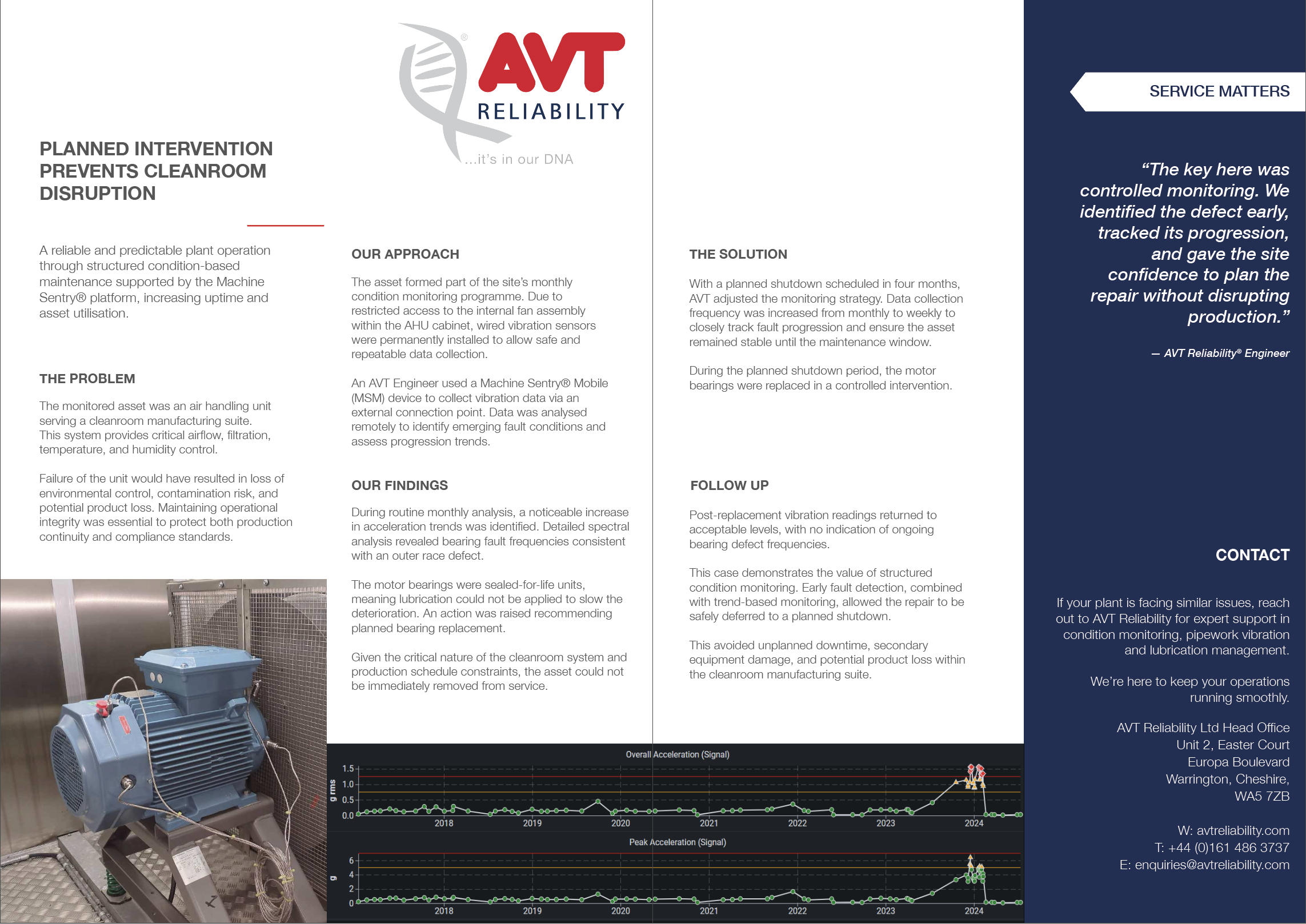
Working to Achieve
A reliable and predictable plant operation through structured condition-based maintenance supported by the Machine Sentry® platform, increasing uptime and asset utilisation.
The Challenge
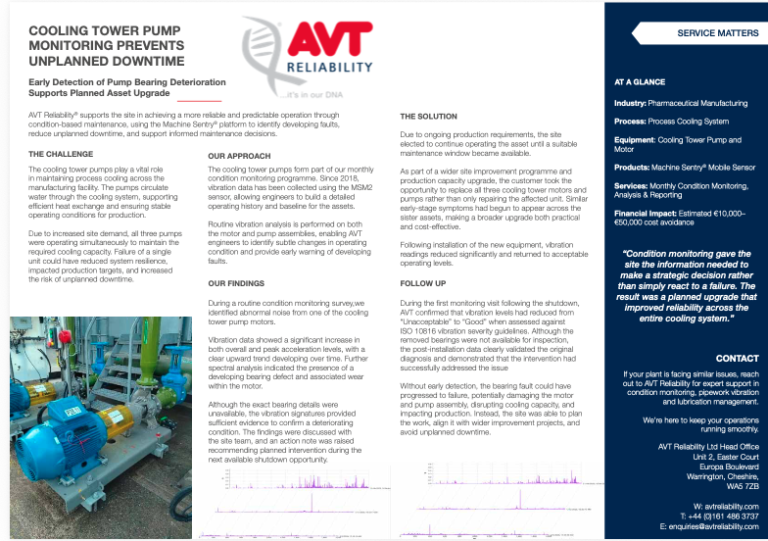
The monitored asset was an air handling unit serving a cleanroom manufacturing suite. This system provides critical airflow, filtration, temperature, and humidity control.
Failure of the unit would have resulted in loss of environmental control, contamination risk, and potential product loss. Maintaining operational integrity was essential to protect both production continuity and compliance standards.
Our Approach
The asset formed part of the site’s monthly condition monitoring programme. Due to restricted access to the internal fan assembly within the AHU cabinet, wired vibration sensors were permanently installed to allow safe and repeatable data collection.
An AVT Engineer used a Machine Sentry® Mobile (MSM) device to collect vibration data via an external connection point. Data was analysed remotely to identify emerging fault conditions and assess progression trends.
Our Findings
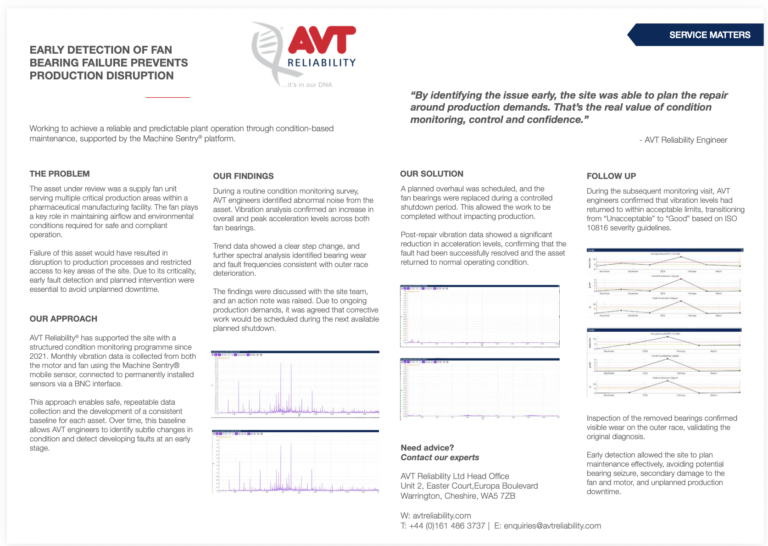
During routine monthly analysis, a noticeable increase in acceleration trends was identified. Detailed spectral analysis revealed bearing fault frequencies consistent with an outer race defect.
The motor bearings were sealed-for-life units, meaning lubrication could not be applied to slow the deterioration. An action was raised recommending planned bearing replacement.
Given the critical nature of the cleanroom system and production schedule constraints, the asset could not be immediately removed from service.
The Solution
With a planned shutdown scheduled in four months, AVT adjusted the monitoring strategy. Data collection frequency was increased from monthly to weekly to closely track fault progression and ensure the asset remained stable until the maintenance window.
During the planned shutdown period, the motor bearings were replaced in a controlled intervention.
Follow-Up
Post-replacement vibration readings returned to acceptable levels, with no indication of ongoing bearing defect frequencies.
This case demonstrates the value of structured condition monitoring. Early fault detection, combined with trend-based monitoring, allowed the repair to be safely deferred to a planned shutdown.
This avoided unplanned downtime, secondary equipment damage, and potential product loss within the cleanroom manufacturing suite.
"The key here was controlled monitoring. We identified the defect early, tracked its progression, and gave the site confidence to plan the repair without disrupting production."
AVT Reliability Engineer