

Viscoelastic Dampers
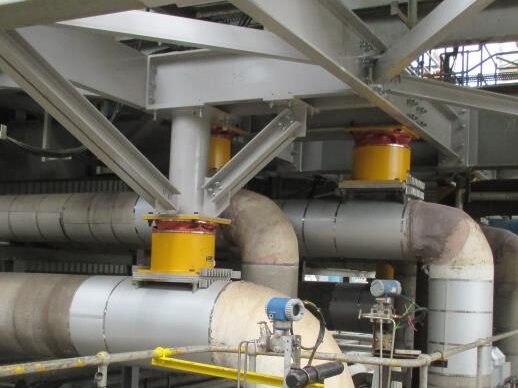
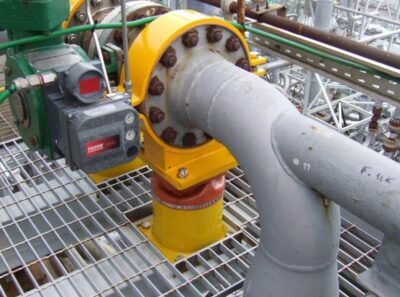
Viscoelastic dampers are an alternative to fixed pipe support systems that reduce vibrations and pipework fatigue.
Viscoelastic Dampers
In many applications, pipework requires a degree of freedom and fixed supports are not always ideal. Viscoelastic dampers apply dynamic restraint while still allowing the thermal movement that occurs as machinery and process conditions change. The result is reduced vibration without compromising the flexibility needed for safe operation.
AVT Reliability® supplies high-quality viscoelastic dampers. These devices generate a resisting force proportional to the speed of movement, providing targeted dynamic support where it is needed most to protect pipework and connected equipment.
What are Viscoelastic Dampers?
Viscoelastic dampers add dynamic restraint to pipework while still allowing the thermal movement that fixed supports restrict. Key advantages include:
| Providing dynamic restraint Controls vibration by delivering a resisting force proportional to movement speed. |
Permitting thermal movement Accommodates expansion and contraction without overloading nozzles or supports. |
| Works over a broad frequency range Effective in all degrees of freedom for multi-axis pipe motion. |
Protection against shock Dampens steady-state vibration and transient shock events. |
| Maintenance-free design No routine servicing required for typical applications. |
Range of sizes Available in multiple capacities to suit line size and load conditions. |
Controls vibration by delivering a resisting force proportional to movement speed.
Accommodates expansion and contraction without overloading nozzles or supports.
Effective in all degrees of freedom for multi-axis pipe motion.
Dampens steady-state vibration and transient shock events.
No routine servicing required for typical applications.
Available in multiple capacities to suit line size and load conditions.
 |
 |
 |
Viscoelastic Damper Applications
Viscoelastic dampers can be deployed across a wide range of piping systems and industries to control dynamic movement while preserving the thermal flexibility your process requires.
A pipework vibration assessment identifies lines and supports at risk of fatigue. Where elevated vibration is found, dampers are added to reduce motion and lower the likelihood of failure.
| Main process lines Long, flexible runs where flow-induced vibration or transients excite the pipe span. |
Equipment tie-ins Suction and discharge lines on pumps, compressors, and fans that impose nozzle loads. |
Thermal growth services Hot lines that must accommodate expansion without sacrificing vibration control. |
| Small-bore connections (SBC) Branches and taps where local flexibility increases fatigue risk. |
Unsupported or remote spans Pipe sections with limited steelwork where stiffness upgrades are impractical. |
Shock and transient control Lines subject to start-up, trip, or valve-slam transients requiring added damping. |
Long, flexible runs where flow-induced vibration or transients excite the pipe span.
Suction and discharge lines on pumps, compressors, and fans that impose nozzle loads.
Hot lines that must accommodate expansion without sacrificing vibration control.
Branches and taps where local flexibility increases fatigue risk.
Pipe sections with limited steelwork where stiffness upgrades are impractical.
Lines subject to start-up, trip, or valve-slam transients requiring added damping.
Applications span oil and gas, petrochemical, chemical, power, mining, water, and food & beverage facilities.

Canadian-Based Support
AVT services are delivered by our expert team based in Canada and supported by the global AVT Reliability network. We support clients across the country, from manufacturing and food processing to energy, mining, and infrastructure.
