Offshore Pipework Vibration Risk Identified
Assessment found 15 small-bore locations above Energy Institute vibration thresholds and guided corrective action
OffshoreProducts used
Machine Sentry Mobile MSM2
Working to Achieve
Reduced risk of pipework fatigue failure and improved asset integrity by identifying and mitigating excessive vibration in Small-Bore Connections (SBCs) across offshore production systems.
The Challenge
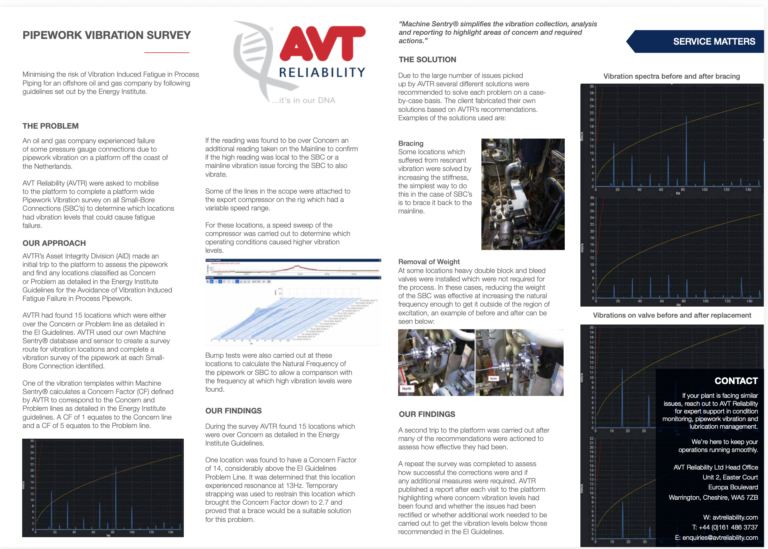
An offshore oil and gas operator experienced pressure gauge connection failures linked to excessive pipe vibration on a platform
located off the coast of the Netherlands. These failures highlighted a broader concern: undetected high vibration levels in small-bore connections could lead to fatigue cracking, process leaks, or more serious safety and financial consequences.
Our Approach
AVT Reliability’s Asset Integrity Division (AID) carried out a full platform-wide Small-Bore Connection (SBC) vibration survey using our Machine Sentry® mobile system. The process followed the Energy Institute’s Guidelines for the Avoidance of Vibration Induced Fatigue Failure in Process Pipework (2nd edition) and included:
- Initial visual inspection to locate common design or installation weaknesses.
- Vibration survey of each SBC using Machine Sentry® sensors, with real-time Concern Factor (CF) calculations
- Concern Factor (CF) scale:
» CF < 1 = Acceptable
» CF 1–5 = Concern
» CF > 5 = Problem
For any reading over the Concern threshold, additional measurements were taken on the parent pipe to confirm if vibration was localised or transferred. Where lines were connected to the variable- speed export compressor, a speed sweep was performed to detect vibration behaviour under different operating conditions. Bump testing was used to identify resonant frequencies and match them to observed vibration.
Our Findings
AVTR identified 15 SBC locations with vibration levels exceeding the EI “Concern” threshold, including one with a Concern Factor of 14—far above the “Problem” threshold of 5. At this location, resonance was confirmed at 13Hz. Temporary strapping was installed to simulate a brace, which successfully reduced the CF to 2.7 and validated that a permanent brace would be effective.
Other findings included:
- High resonance on unsupported lines
- Heavy, unnecessary valves contributing to low natural frequencies
- Multiple SBCs in excitation zones due to line flexibility and process dynamics
The Solution
Each issue was addressed on a case-by-case basis with AVTR’s recommendations forming
the basis for client-led corrective actions. These included:
- Bracing: Increasing stiffness to move the natural frequency away from the excitation range
- Weight reduction: Removal of non- essential heavy valves to reduce mass and raise resonant frequency
- Optimised design adjustments: Tailored solutions based on vibration frequency, pipe support condition, and layout
constraints
The client fabricated and installed solutions in-house based on AVTR’s specifications.
Follow-Up
A return visit was carried out after the initial recommendations were implemented. AVTR repeated the full survey, confirmed significant
vibration reductions, and documented the remaining areas for improvement.
All findings were compiled into formal reports, ensuring traceability of actions and alignment with Energy Institute guidance.
At a Glance
- INDUSTRY: Offshore Oil & Gas Platform
- PROCESS: Hydrocarbon Production – Pressure Monitoring
- EQUIPMENT: Multiple Small-Bore Connections
- PRODUCTS: Machine Sentry® Sensors
- SERVICES: Platform-wide pipework vibration survey, resonance analysis, inspection